


Security Researcher at Cyberint

Originally Published: November 2nd 2023
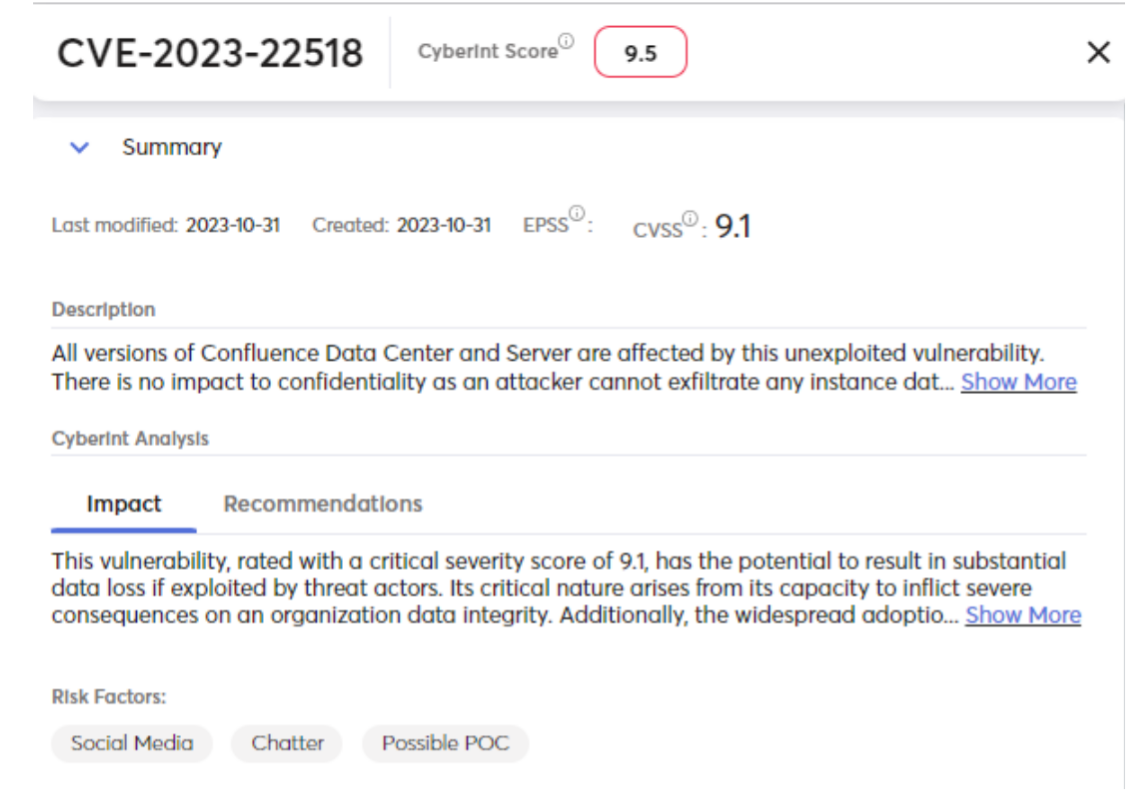
On October 31st, Atlassian disclosed a significant security vulnerability tracked as CVE-2023-22518, affecting all versions of Confluence Data Center and Confluence Server software. This vulnerability, rated with a critical severity score of 9.1 in the Common Vulnerability Scoring System (CVSS), has the potential to result in substantial data loss if exploited by threat actors.
Its critical nature arises from its capacity to inflict severe consequences on an organization’s data integrity. Additionally, the widespread adoption of Confluence in numerous organizations magnifies the risk.
Atlassian’s Confluence Data Center and Confluence Server are popular platforms for knowledge sharing, document creation, and collaborative work, utilized by millions of users across various industries, including technology, finance, healthcare, government, and education.
Indications of forthcoming Proof of Concepts (POCs) have been detected by Cyberint. A group using the name “C3RB3R” claimed in a ransom note had exploited the Atlassian bug. Atlassian responded with “We received a customer report of an active exploit. Customers must take immediate action to protect their instances. If you already applied the patch, no further action is required”.
This disclosure follows a recent warning from CISA, FBI, and MS-ISAC, urging network administrators to promptly apply patches to address an actively exploited privilege escalation vulnerability tracked as CVE-2023-22515 in Atlassian Confluence servers.
This vulnerability had been observed to be exploited by a threat group known as ‘Storm-0062’ (also referred to as DarkShadow or Oro0lxy) to carry out a critical privilege escalation zero-day attack on Atlassian Confluence Data Center and Server, starting on September 14, 2023.
The publishing of these issues, which were found through the company’s bug bounty program and internal pen-testing marks a change in Atlassian’s vulnerability disclosure policy. Until now the company only disclosed first part critical-severity vulnerabilities, but this has been expanded to high severity issues as well. “While this change results in an increase of visibility and disclosures, it does not mean there are more vulnerabilities,” the company said. “Rather that we are taking a more proactive approach to vulnerability transparency and are committed to providing our customers with the information they need to make informed decisions about updating our products”.
Threat actors who exploit this vulnerability can create unauthorized Confluence administrator accounts and gain access to Confluence instances. Although this action carries severe implications and can have devastating consequences for organizations, it’s crucial to highlight that those exploiting this vulnerability cannot exfiltrate any instance data. Their impact is limited to potentially destroying data on the affected servers.
This Improper Authorization vulnerability impacts all versions preceding the designated fix versions of Confluence Data Center and Server. Specifically:
All versions before the following fixed versions:
All versions before the following fixed versions:
It’s worth noting that Atlassian Cloud sites accessed via an atlassian.net domain remain unaffected by this vulnerability.
There are several more vulnerabilities:
The new Atlassian vulnerabilities can be explored further in Adi Bleih’s blog here.
Cyberint recommends the following actions to mitigate the associated risks with this vulnerability:
To learn more about how our threat intelligence research helps protect businesses against ransomware and other risks, request a demo.