Solution
One brain powering Threat Intelligence, Dark Web Monitoring, Attack Surface Management, Brand Protection, and Supply Chain Intelligence, because when everything thinks together, accuracy follows.























Watch Everything Connect
Why Switch to Us?
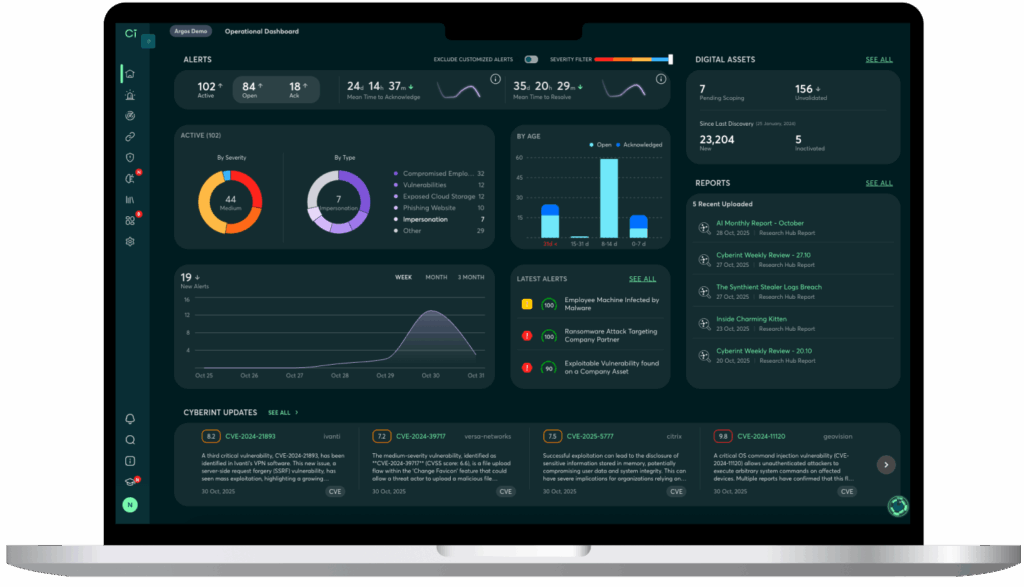


The Power of Consolidation





Evans Duvall, Cyber Security Engineer at Terex

In the POV we realized that Infinity ERM was much more than an EASM solution, it delivered much value with highly relevant intelligence from the deep and dark web.
Benjamin Bachmann, Head of Group Information Security Office at Ströer

We looked at some other vendors and they have good solutions, but we needed more than what they could offer. With Infinity ERM, I can continuously monitor not only all of Phoenix Petroleum’s domains, but all our digital assets, plus we get relevant intelligence from the deep and dark web.
Roland Villavieja, Information Security Officer at Phoenix Petroleum

We were looking to establish a new threat intelligence capability within Questrade and, in order to support that, we needed to have a platform that would give us deep insights.
With Infinity ERM, we’re not only getting intelligence from the general landscape but we’re also getting intelligence that’s really tailored to us and our environment.
Shira Schneidman, Cyber Threat & Vulnerability Senior Manager at Questrade

Once we identified the need to address the risk of fraudulent websites and social profiles, I quickly realized we needed to handle this in a scalable manner. Our solution is to use Infinity External Risk Management to help us automatically detect and takedown these threats.
Ken Lee, IT Risk and Governance Manager at WeBull

FAQs
How does the integration with Check Point affect the Cyberint platform’s roadmap and support?
After the acquisition by Check Point Software Technologies Ltd. (October 2024), Cyberint platform has been integrated into Check Point’s Infinity architecture.
What this means for customers:
-
You’ll see tighter linkage between external risk management capabilities and Check Point’s broader product ecosystem, meaning more data and faster fixes.
- You will be able to consolidate your cyber tech stack even further. Intelligence, prevention, and response operate through a single ecosystem rather than a patched-together stack.
Can I still engage with Cyberint as a standalone contract or do I have to go through Check Point?
The platform formerly branded “Cyberint” is now positioned as part of Check Point’s External Risk Management (ERM) offering.
Yet, you can still buy External Risk Management as a standalone offering, speak to External Risk Management salespeople and analysts and have your own External Risk Management customer support rep.
What exactly constitutes “external cyber risk” and which risk vectors does the platform cover?
“External cyber risk” means vulnerabilities and threats coming from outside-in e.g. internet-facing assets, cloud storage misconfigurations, leaked credentials, third-party vendor exposures, impersonation of your brand, deep & dark web activity.
-
Key risk vectors covered by the platform:
-
Attack surface management: discovery of assets (domains, subdomains, IPs, cloud storage) plus exposure detection (open ports, misconfigurations etc).
-
Threat intelligence / deep & dark web: monitoring what is being said, leaked, sold, or impersonated about your organization.
-
Brand protection: detection of fraudulent websites, social media impersonation, etc. ﹙implied by the platform messaging﹚
-
Third-party / supply-chain risk: risks arising from vendors or technologies you depend on.
-
Which modules can I activate/pay for separately (e.g., brand protection, supply-chain intelligence) vs. all-in-one?
The platform supports modular architecture, with Attack Surface Management (ASM), Threat Intelligence, Supply Chain Intelligence, Brand Protection offered separately.
But the solution offers the most value when these modules are bought together as they combine to reduce false positives, increase prioritization and are much more cost efficient when bought together.
How do you avoid flooding us with low-value alerts (false positives) and ensure actionable intelligence for our team?
The platform emphasizes “Impactful Intelligence” and we live by that promise with a 93% true positive rate. Not only that, but each alert is enriched with context (code, screenshots and more), meaning not only are the alerts accurate but they are designed to be actionable.
Techniques used:
- Continuous monitoring and correlation of intelligence (not just raw feeds).
- The platform combines multiple data streams (Check Point’s global network data + Cyberint’s intelligence + OSINT) for higher confidence in IOCs.
- Risk-scoring asset and exposure; focusing on prioritisation rather than noise.
- Correlation between Attack Surface Management and Threat Intelligence – We only alert when intelligence matches your real assets, not generic internet noise.
- Credential-leak filtering based on your password policies
- If the leaked password format doesn’t match how your org structures passwords, we suppress it. No pointless “password123” alerts for accounts that can’t possibly be yours.
- Weighted multi-source confirmation: Intelligence signals from dark-web forums, marketplaces, Check Point telemetry and OSINT must reinforce each other before elevating an alert.
- Automated deduplication across sources – One leaked mention shouldn’t become five alerts. Correlation logic merges duplicates automatically.
- Human analysts verify ambiguous dark-web intel, stolen data samples and high-risk takedown-eligible items before you ever see them.
These are only some of the ways we make sure our alerts are true positives.
What’s the onboarding timeline — how quickly can we get up and running and see value?
We can deliver actionable intelligence within 20 minutes after setup. Since it’s an agentless SaaS offering (no on-prem installation), deployment time is faster than typical enterprise installs.
Full value (dashboarding, integration, remediation workflow) may take a few days to a couple of weeks depending on your complexity, as AI optimizes to your needs and the information feeds into the solution to enable a high true positive rate.